
In Part 4 of our AgriEnergy Cycle series, we looked at Energy — how a healthy plant captures sunlight through photosynthesis and builds the energy it needs to grow, reproduce and respond to the conditions around it.
But plants don't produce energy just to have it.
They put it to work.
Some of that energy goes into building leaves, stems and reproductive tissue above ground. A significant portion also goes below ground, building and maintaining the root system that supplies the plant with water and nutrients.
That brings us to the fifth stage of the AgriEnergy Cycle: Plant & Root Growth.
And when it comes to roots, one idea matters more than almost anything else:
More healthy roots mean more opportunity.
Roots Do Much More Than Hold the Plant Up
We don't see roots when we drive past a field, so it is easy to focus most of our attention on what is happening above ground.
But the crop above the soil depends heavily on what is happening below it.
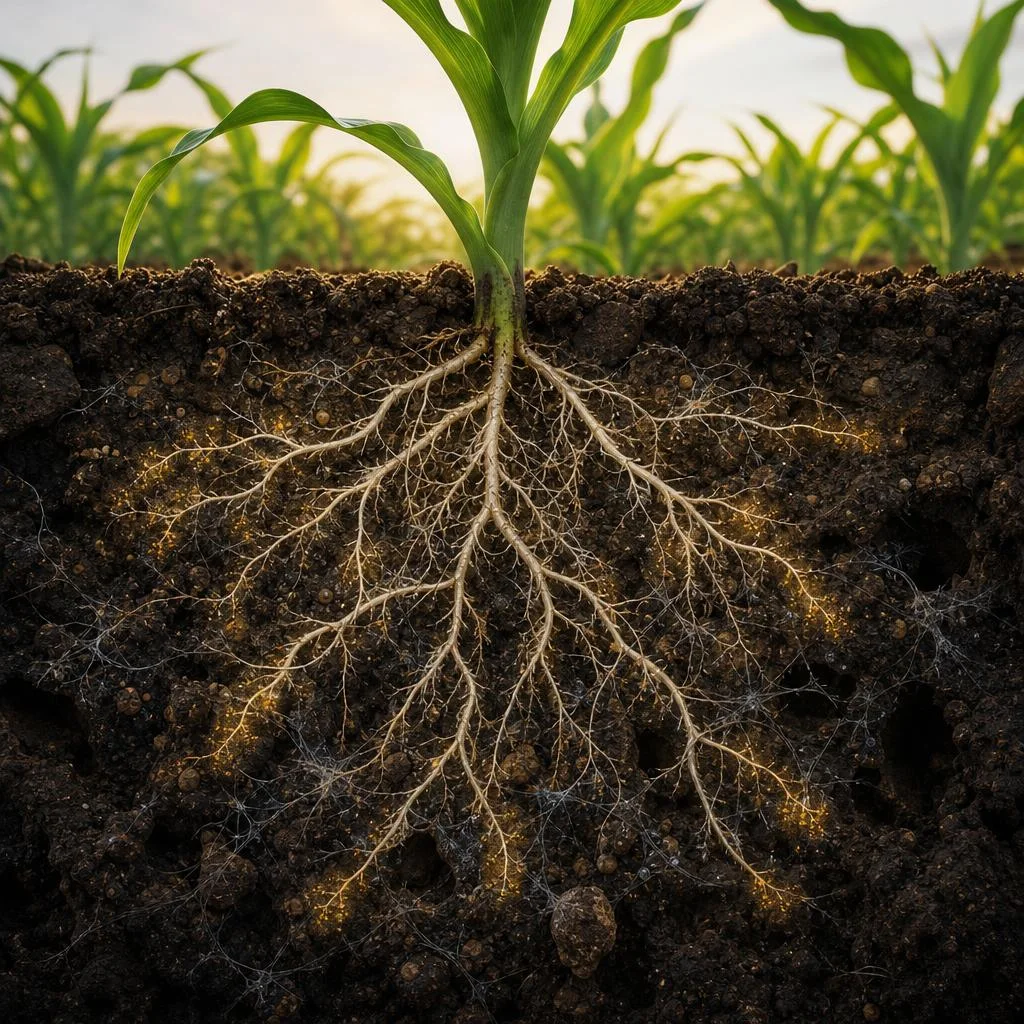
Roots explore the soil looking for water and nutrients. As the root system expands, the plant gains access to a larger volume of soil. More soil explored means more opportunities to encounter moisture and available fertility.
A small, restricted root system has fewer options.
A larger, healthier root system gives the plant more places to look.
That becomes especially important when growing conditions are less than ideal.
More Roots Mean More Soil to Explore
Imagine two plants growing side by side.
One develops a deep, well-branched root system that spreads throughout the soil profile. The other encounters compaction and develops a smaller root system concentrated near the surface.
Even if both plants are growing in soil with similar fertility, they do not have equal access to it.
The plant with the larger root system is exploring more soil. It has access to a larger reservoir of water and more opportunities to intercept nutrients.
The restricted plant is trying to support itself from a much smaller area.
This is why we have emphasized throughout the AgriEnergy Cycle that nutrient availability and nutrient access are not the same thing.
The fertilizer can be there.
The roots still have to reach it.
Root Growth Depends on the Environment
Roots will grow where the soil allows them to grow.
When soil has good structure and adequate pore space, roots have pathways to move through the profile. When soil becomes dense and compacted, those pathways become harder to find.
That can lead roots to turn sideways, follow cracks or remain concentrated in shallower portions of the soil.
AgriEnergy has seen this difference clearly in field work. In replicated corn plots at North Carolina State University, plants from treated areas showed roots moving more directly through compacted soil while untreated roots were much more irregular and restricted. See the field comparison.
The lesson is bigger than any individual treatment.
Roots perform best when we give them an environment they can explore.
Compaction Shrinks the Plant's World
Compaction doesn't simply make the soil harder.
It effectively makes the plant's usable world smaller.
When roots cannot penetrate a dense layer, the crop loses access to some of the water and fertility below or beyond that restriction. Reduced pore space can also limit oxygen and slow water movement through the profile.
That is why soil compaction can create problems that look like fertility or water issues above ground.
A crop may be sitting above nutrients it cannot reach.
It may have moisture deeper in the profile that its roots cannot access.
And when dry conditions arrive, the difference between a shallow root system and a deeper one can become much more important.
The goal isn't simply to grow more roots.
It is to help the crop build roots where they can do useful work.
Don't Forget About New Roots
A root system is not something the plant builds early and then simply carries for the rest of the season.
Roots continue to grow and change as the crop develops.
That matters because nutrient and water demand can increase dramatically as the plant gets larger. AgriEnergy has long emphasized that maintaining new, healthy root tissue through the season is important as crop demand rises.
A crop entering reproduction has a much larger job than a young seedling.
It needs to support the plant above ground while continuing to supply water and nutrients during a period when reproductive demand may be increasing quickly.
That means root health matters well beyond emergence.
An excellent root system in May still has work to do in July.
Bigger Above Ground Requires Support Below Ground
We often celebrate rapid vegetative growth.
And for good reason. Healthy leaf area gives the plant more capacity to capture sunlight and produce energy.
But as the crop gets larger above ground, the demand placed on the root system increases too.
More leaf area means more water moving through the plant. More plant tissue requires more nutrition. Reproductive growth adds another major demand.
That creates an important balance.
The plant above ground can only perform as well as the system below ground can support it.
This is why strong plant growth and strong root growth shouldn't be thought of as competing goals.
They have to develop together.
What Should You Look For?
This is one of the easiest stages of the AgriEnergy Cycle to investigate yourself.
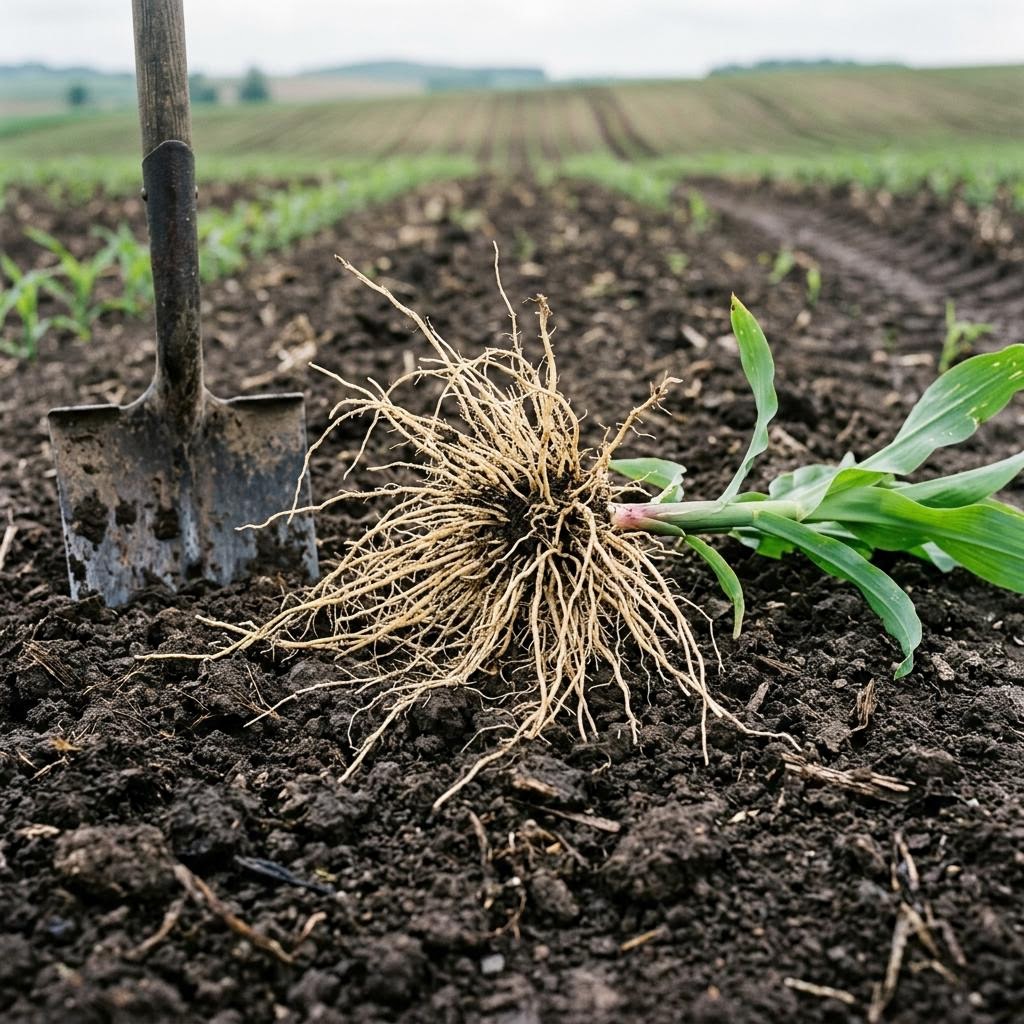
Dig some plants.
Don't just pull them from the ground. Use a shovel and take enough soil with the plant that you can see how the roots are actually growing.
- Look at depth. Are roots moving downward through the profile?
- Look at spread. Are they exploring soil in multiple directions?
- Look for restrictions. Do roots suddenly turn sideways at a particular depth?
- Compare good areas of the field with weaker ones.
- And pay attention to the soil around the roots. Is it loose and aggregated, or dense and difficult to break apart?
You do not need a laboratory to see when one plant has access to considerably more soil than another.
Sometimes the difference is sitting right there on the shovel.
Don't Judge the Root System From the Top
A healthy-looking plant above ground can sometimes hide limitations below it.
Adequate rainfall may allow a shallow-rooted crop to look perfectly good early in the season. But if conditions turn dry later, that limited root system may suddenly become a much bigger problem.
The same can happen with fertility.
When nutrients are readily available near the surface, restricted rooting may not immediately show itself. As demand grows or surface conditions change, the plant may no longer have enough reach to keep up.
That is one reason digging plants throughout the season can be so useful.
Don't wait until a problem becomes visible from the road.
Look underneath.
Build the Opportunity Before the Crop Needs It
One of the challenges with roots is that you cannot suddenly build a deep, healthy root system the day drought arrives.
The opportunity has to be created earlier.
Good soil structure, active biology, available nutrition and proper moisture conditions all help create an environment where roots can continue exploring.
That takes us back through the earlier stages of the AgriEnergy Cycle.
- Soil Biology helps build the environment.
- Soil Nutrients provide the materials.
- Plant Metabolism puts those nutrients to work.
- Energy gives the plant the ability to grow.
- And Plant & Root Growth expands the crop's reach.
Each stage makes the next one possible.
The Bigger the Root System, the Bigger the Connection
There is one more reason root growth matters in the AgriEnergy Cycle.
Roots aren't simply taking from the soil.
They are also giving something back.
As roots grow and become more active, they release sugars and other compounds into the soil surrounding them. Those materials help support the microorganisms living around the root.
That means a larger, healthier root system creates something more than access to water and nutrients.
It creates a larger area where the plant and soil biology can interact.
And that takes us to the final stage of the AgriEnergy Cycle:
Root Exudates.
In Part 6, we'll look at what the plant sends back into the soil — and how that exchange closes the loop we started with Soil Biology.
Continue the AgriEnergy Cycle Series
Next: Part 6: Root Exudates — What the Plant Gives Back
Previous: Part 4: Energy — The Crop's Energy Budget
Part 3: Plant Metabolism — What the Plant Does With What It Gets
Part 2: Soil Nutrients — It's What the Crop Can Use
Start at Part 1: Soil Biology — The Living Engine Beneath Your Feet
Explore: See the complete AgriEnergy Cycle