
In Part 5 of our AgriEnergy Cycle series, we looked at Plant & Root Growth and the opportunity a larger, healthier root system gives the crop to explore more soil, reach more water and access more nutrients.
But roots aren't only taking from the soil.
They are giving something back.
As a healthy plant captures sunlight and produces carbohydrates, some of that energy moves below ground through the roots. The plant releases natural sugars and other compounds into the soil surrounding those roots.
These are root exudates, the sixth and final stage of the AgriEnergy Cycle.
And this is where the Cycle finally comes back to where we started.
What Are Root Exudates?
Root exudates are compounds released by living roots into the soil immediately around them. They include sugars, amino acids, organic acids and other materials produced by the plant.
For our purposes, the important part is simpler than the chemistry.
They are food for biology.
The plant captures energy above ground through photosynthesis, moves some of that energy below ground and releases carbon-rich compounds around its roots. Microorganisms living in that area can use those compounds as a food source.
That makes roots much more than pipes bringing water and nutrients into the plant.
They are also a connection between the plant and the biological community around it.
The Busy Area Around the Root
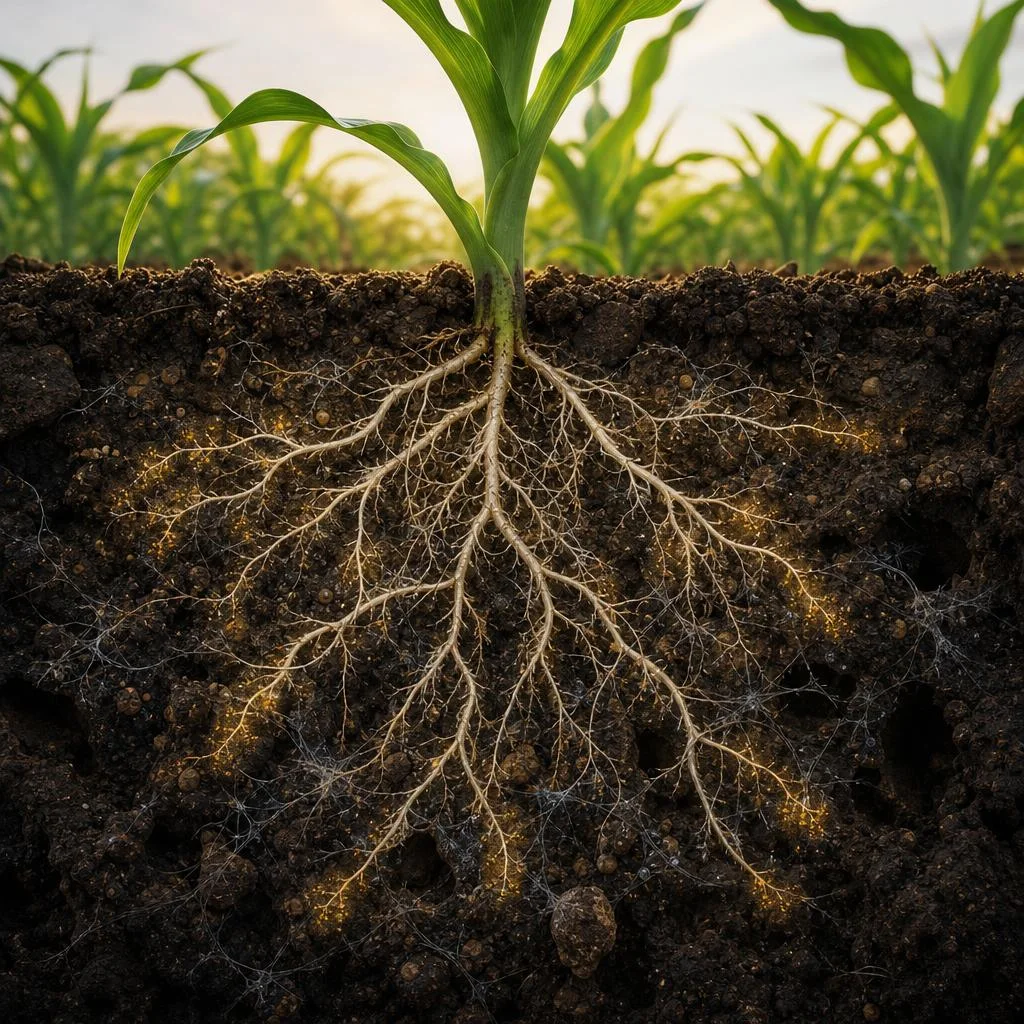
The soil immediately surrounding an active root is often referred to as the rhizosphere.
That sounds technical, but the concept is pretty straightforward: where you have actively growing roots, you have an area where the plant and soil biology are interacting very closely.
The plant releases compounds from its roots. Microorganisms use those compounds. Biological activity helps cycle nutrients in the root zone. Those nutrients can then become available to the plant.
AgriEnergy has talked about this root-zone exchange for years. In our Pore Space & Tilth work, active rhizospheres, good pore space, healthy roots and biologically created aggregates were all visible signs of a soil system functioning well.
The root isn't operating by itself.
Neither is the biology.
They are working in the same space.
Healthy Plants Can Feed the Soil Better
This is where the earlier stages of the Cycle begin to matter again.
A plant needs available nutrients to support metabolism. It needs healthy leaf tissue to capture sunlight. It needs energy to build roots and above-ground growth. And it needs an active root system to create a strong connection with the soil around it.
When those pieces are working well, a healthier plant has more capacity to produce carbohydrates and send some of that energy below ground.
That gives us another way to think about crop health.
We're not only trying to grow a plant that can take more from the soil.
We're trying to grow a plant capable of putting more back into the system.
That is one of the central ideas behind the AgriEnergy Cycle.
More Roots Create More Connection
Part 5 focused on why a larger, healthier root system gives the crop more opportunity to explore the soil.
There is another side to that.
More healthy root growth also creates more contact between the plant and the soil biology surrounding those roots.
Every new section of active root expands the area where that exchange can happen. The plant has more opportunity to access water and nutrients, while the biological community has more opportunity to interact with compounds released by the root.
This is why root development and root exudates fit next to one another in the Cycle.
The plant invests energy into roots.
Those roots expand through the soil.
And those active roots begin feeding energy back into the biological system.
Biology Has to Be There to Receive It
Of course, releasing root exudates is only part of the story.
There needs to be an active biological community around the roots capable of using them.
That takes us all the way back to Part 1: Soil Biology — The Living Engine Beneath Your Feet.
We started this series by talking about the importance of creating an environment where biology can function: adequate air and moisture, good soil structure, available carbon and room for roots to grow.
Now we can see another reason those conditions matter.
A healthy plant may be supplying food below ground, but the soil environment still needs to support the organisms we're asking to use it.
Once again, the answer isn't one isolated product or application.
It is the system.
Exudates and Residue Aren't the Same Thing
There are several ways plants return carbon to the soil, and it is useful to separate them.
Crop residue is the material left behind — stalks, leaves, husks and roots that biology can begin processing and recycling. We've talked extensively about residue management and the nutrients contained in that material.
Root exudates are different because this exchange is happening while the plant is alive and actively growing.
The living root is continually interacting with the soil around it.
That gives us two important pathways.
During the growing season, active roots feed biology around the root zone.
Afterward, roots and above-ground residue become additional material for biology to process.
The crop continues contributing to the soil system even as the form of that contribution changes.
You Can't See the Sugar — But You Can Look at the System
Root exudates aren't something you're going to walk into the field and see with your eyes.
But just as we discussed with Soil Biology in Part 1, there are plenty of things you can observe around them.
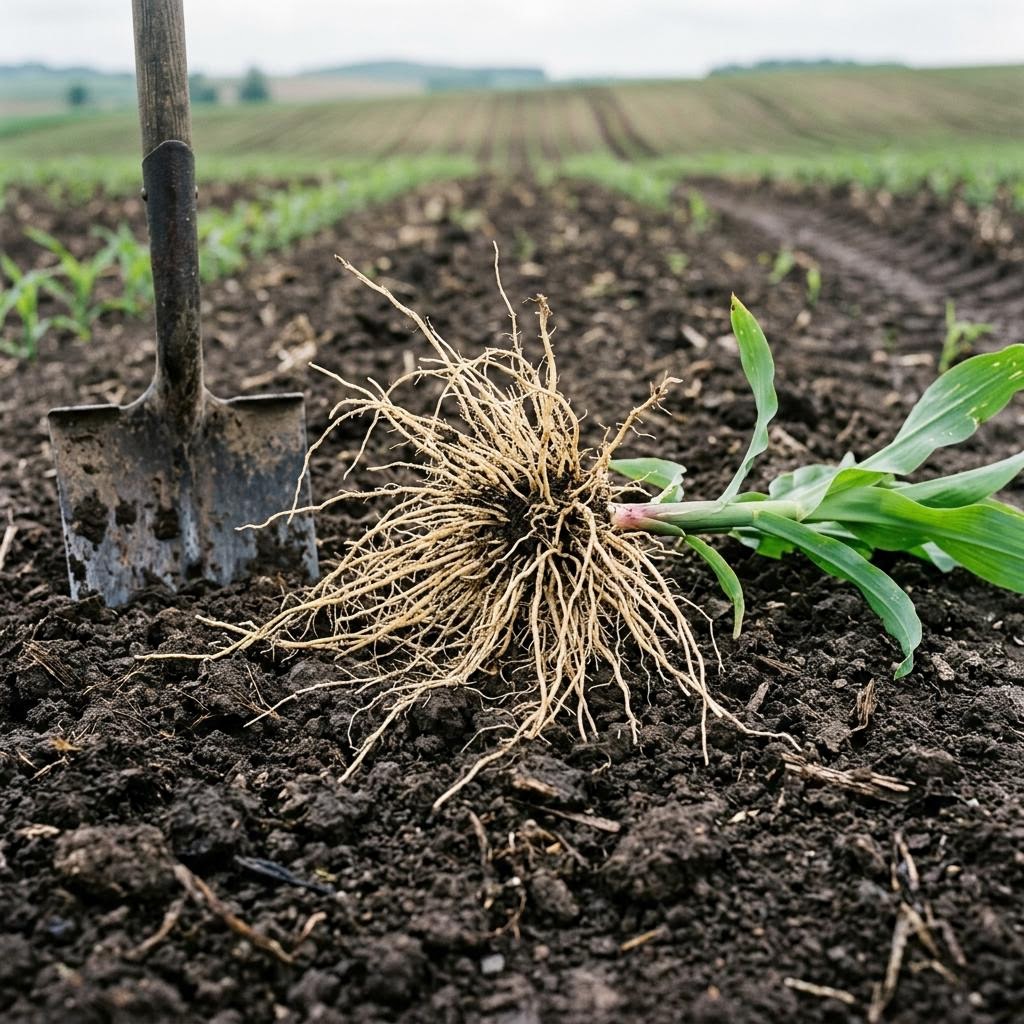
Dig some plants and look at the roots. Are they white and actively growing? Are they branching and exploring the soil, or are they restricted?
Look at the soil around those roots. Is there good aggregation and pore space? Does the soil crumble apart, or does it come out in dense blocks?
Look at the crop above ground. Is it maintaining healthy leaf area and continuing to grow, or is stress limiting the system?
And compare different areas of the field. Some of the most useful information can come from putting a strong plant and a struggling plant side by side and asking what is different below ground.
You may not be able to see root exudates directly.
But you can evaluate the plant and soil system responsible for producing and using them.
Don't Try to Manage the Last Stage by Itself
This may be the most important lesson of Part 6.
If you want more of the benefits associated with healthy root activity and root exudates, you don't simply jump to the last stage of the Cycle.
You work on the stages that lead to it.
Support soil biology.
Make nutrients available.
Build balanced plant nutrition.
Keep the plant functioning.
Protect its ability to produce energy.
Encourage strong plant and root growth.
When those pieces are working together, the final stage becomes a natural result of everything that came before it.
That's what makes the AgriEnergy Cycle different from thinking about crop management as a series of unrelated inputs.
Each stage creates the opportunity for the next one.
And We're Back to Soil Biology
Six articles ago, we started beneath our feet.
Soil Biology helps break down organic material and cycle nutrients.
Those Soil Nutrients become available to the plant.
Plant Metabolism puts those nutrients to work.
Healthy metabolism helps the plant produce Energy.
That energy drives Plant & Root Growth.
And those growing roots release Root Exudates that feed biology back in the soil.
Then it starts again.
Soil Biology → Soil Nutrients → Plant Metabolism → Energy → Plant & Root Growth → Root Exudates → Soil Biology
That is why we call it a Cycle.
There really isn't a beginning or an end.
Build the Next Crop While Growing This One
When we introduced the AgriEnergy Cycle, we used a simple idea:
Better soil builds better plants — and better plants build better soil.
Root exudates show us exactly how literal that relationship can be.
The soil helps support the crop. The crop captures energy. The plant sends some of that energy back below ground. That helps support the biology responsible for cycling nutrients and building the soil environment that the crop — and the crop that follows it — will depend on.
The goal isn't just to take enough from a field to produce this year's crop.
It is to manage the crop and soil in a way that keeps the system moving.
Because a healthy plant isn't only the result of healthier soil.
It can become part of building healthier soil, too.
And that closes the AgriEnergy Cycle.
Continue the AgriEnergy Cycle Series
Previous: Part 5: Plant & Root Growth — More Roots, More Opportunity
Part 4: Energy — The Crop's Energy Budget
Part 3: Plant Metabolism — What the Plant Does With What It Gets
Part 2: Soil Nutrients — It's What the Crop Can Use
Back to Part 1: Soil Biology — The Living Engine Beneath Your Feet
Explore: See the complete AgriEnergy Cycle