
A healthy crop doesn't begin with the seed.
It begins with the soil — and what is happening in that soil long before the seed ever goes into the ground.
That is the idea behind the AgriEnergy Cycle. Instead of looking at fertility, soil structure, crop residue, roots and biology as separate pieces, we look at how they work together. Each part of the system influences the next. And when the system is functioning well, the benefits begin to build on one another.
Better soil grows better plants. Better plants feed more biology. More biological activity improves nutrient cycling and soil structure. And that creates an even better environment for the next crop.
It is a cycle — not a one-season treatment.
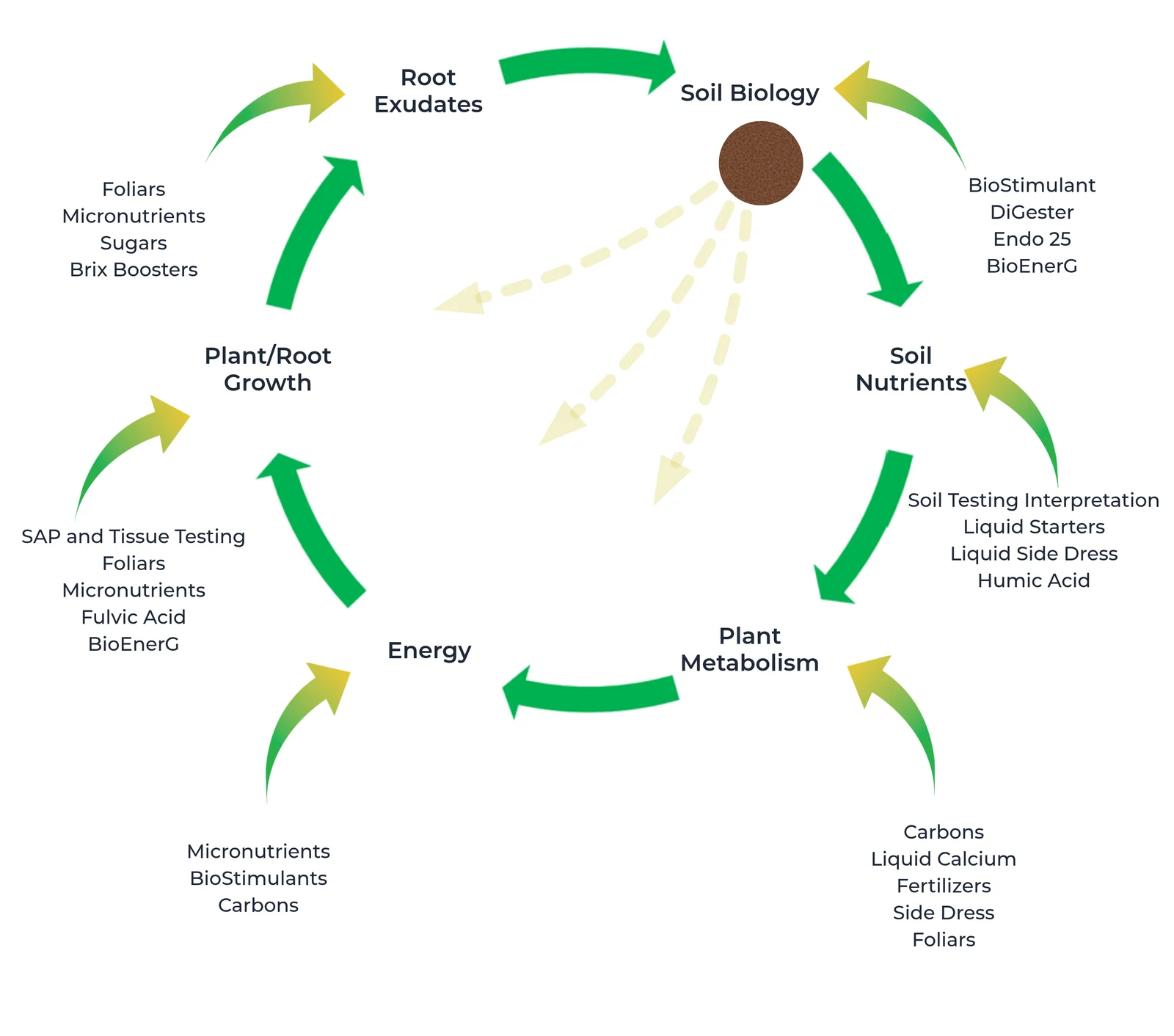
Explore the interactive version on The AgriEnergy Cycle page.
It Starts with the Soil
We have talked for years about three basic principles of regenerative farming:
- Manage air and water in the soil.
- Manage crop residues.
- Manage crop fertility.
These are not independent goals. They are connected.
A biologically active soil forms aggregates — small clusters of soil particles that create pore space. That pore space allows air and water to move through the soil and gives roots room to grow. A healthy soil is often described as roughly 50% pore space: about 25% air and 25% water.
When soil becomes tight and compacted, the entire system has to work harder. Root growth is restricted. Oxygen movement declines. Water infiltration suffers. Biological activity can become less efficient.
Improve that environment, and the cycle begins moving in the other direction.
Healthy Roots Feed a Living Soil
Roots do much more than hold a plant in place and absorb nutrients.
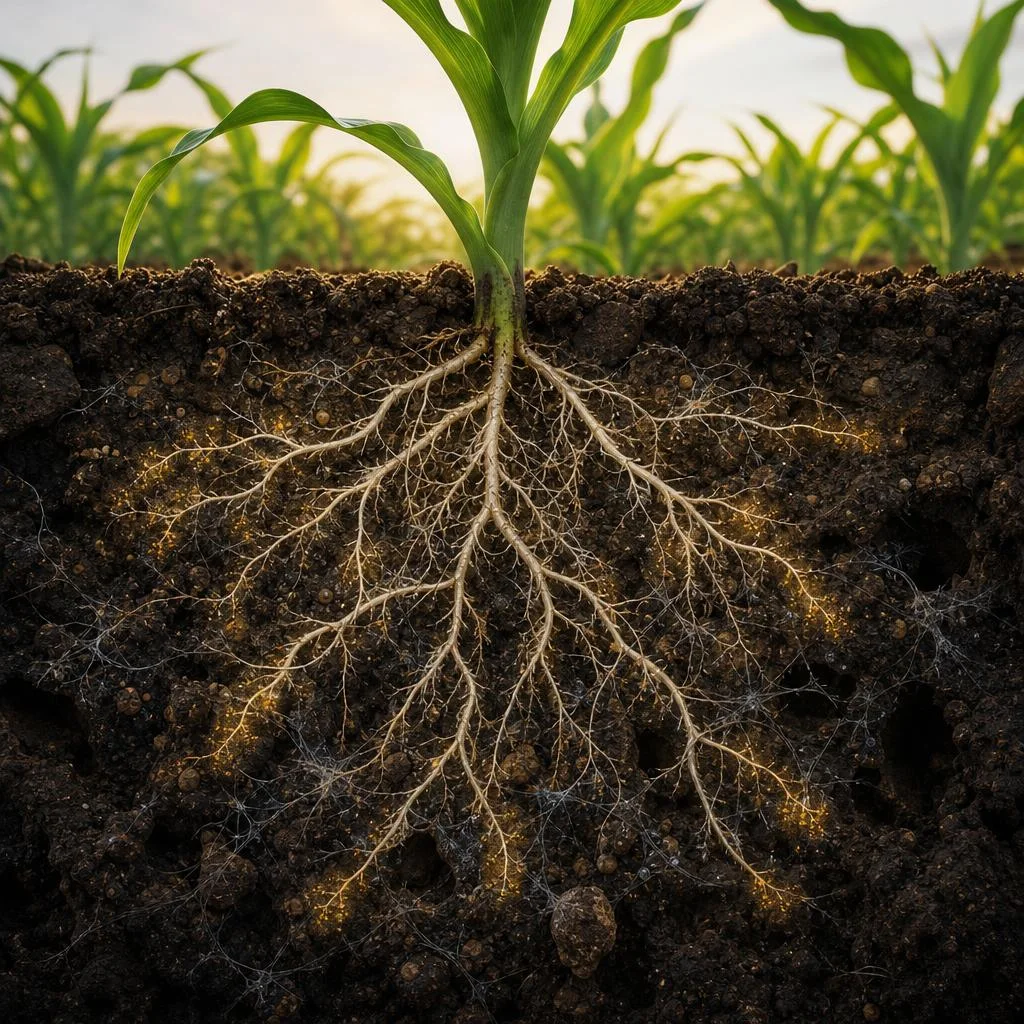
Through photosynthesis, plants capture energy and produce carbohydrates. A portion of that carbon moves below ground through the roots as exudates — including sugars, amino acids, organic acids and other compounds.
Those exudates feed the microbial community surrounding the root: the rhizosphere.
This is where the relationship becomes interesting.
An active rhizosphere helps cycle nutrients and supports plant growth. A healthier plant can then produce more carbohydrates, which means more energy can move back into the root zone to support even more biological activity.
We see the beginning of a positive feedback loop:
Better roots → more root exudates → more biological activity → better nutrient cycling → a stronger plant → better roots.
That exchange between plant and soil is one of the engines driving the AgriEnergy Cycle.
Biology Helps Put Nutrients Back to Work
There can be plenty of nutrients in a field without all of them being readily available to the crop.
That is where soil biology plays an important role.
Microorganisms participate in the decomposition of organic material and the cycling of nutrients from crop residues, cover crops, manures and soil organic matter. As those materials are broken down, nutrients move through biological forms and can eventually become available for plant uptake.
The goal, therefore, is not simply to add fertility.
It is to create a soil environment capable of using and recycling fertility efficiently.
This changes the question from "How much fertilizer can we put on?" to:
"How effectively can the soil-plant system use what is already there — along with what we add?"
That is an important distinction.
Harvest Is Not the End of the Cycle
When the combine leaves the field, the crop may be harvested — but a tremendous amount of biological material remains.
Stalks, leaves and roots are not simply trash to get out of the way. They are part of the fertility system for the next crop.
Effective residue management helps return nutrients to the soil, reduces nutrient immobilization and creates an opportunity for the following crop to get off to a faster start.
Microbial activity breaks down those residues and begins moving their carbon and nutrients back through the soil system.
And suddenly we are right back where we started:
- Last year's plant becomes food for biology.
- Biology helps build soil.
- That soil supports the next root system.
- The next crop captures more energy.
- And the cycle begins again.
How Do You Keep the Cycle Moving?
There is no single product or application that creates a healthy biological system overnight.
It is management. Look at the whole system.
- Manage air and water. Pay attention to compaction, aggregation, drainage, infiltration and the physical environment roots are trying to grow through.
- Manage residue. Think of crop residue as a resource to be biologically processed and recycled rather than something that simply needs to disappear.
- Manage fertility. Provide balanced nutrition while also considering the biology responsible for cycling nutrients and moving them through the soil-plant system.
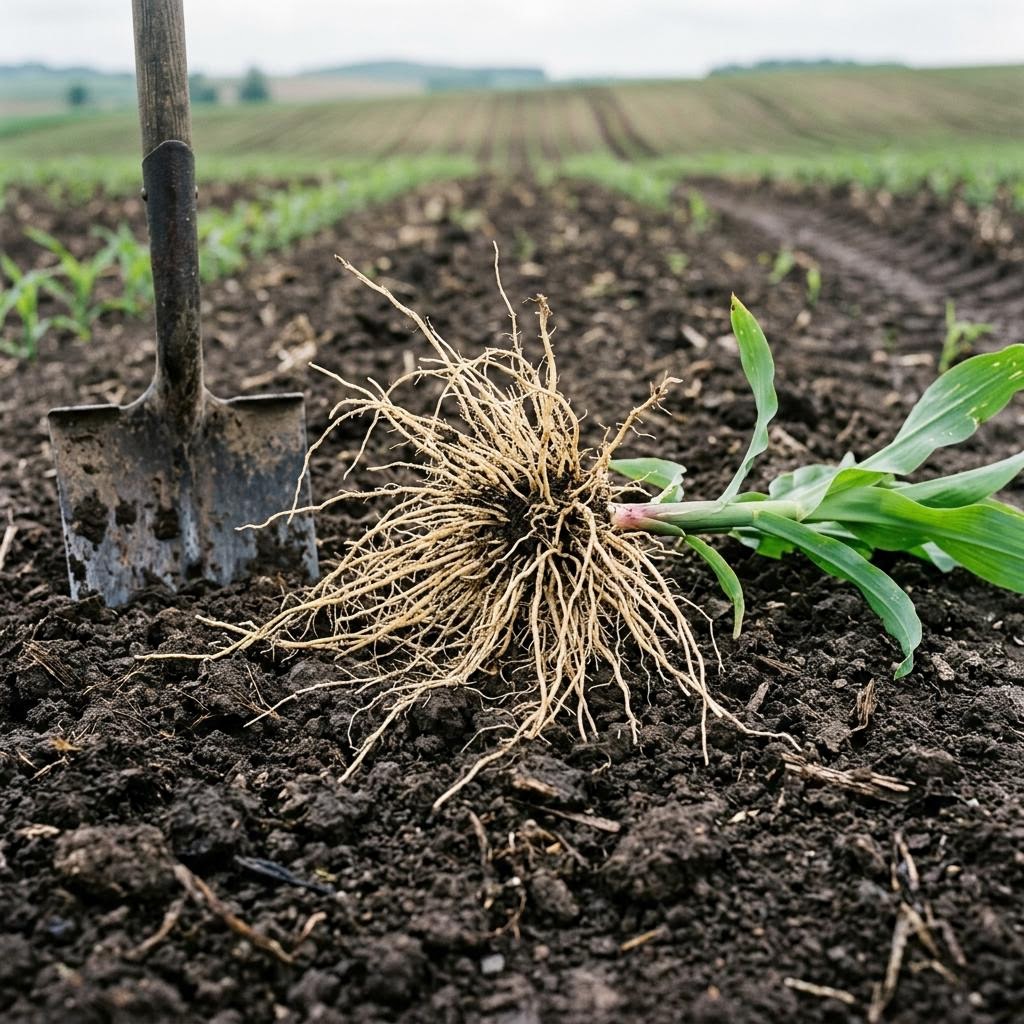
- Pay attention to roots. Dig plants. Look at rooting depth, root color, branching and how easily roots move through the soil. The root system can tell you a great deal about what is happening underground.
- Feed the system, not just the crop. Every management decision affects the biological community that will help support this crop — and the crops that follow.
Build the Next Crop While Growing This One
Perhaps the most important part of the AgriEnergy Cycle is that there really is no beginning or end.
Every crop is influenced by what happened before it.
And every crop has the opportunity to improve the environment for what comes next.
The goal is not simply to produce a healthy plant this season. It is to grow that plant in a way that leaves behind more active biology, better nutrient cycling, stronger soil structure and a healthier starting point for the following crop.
Do that consistently and the system begins working with you.
Healthy soil grows healthy plants. Healthy plants build healthier soil.
That's the AgriEnergy Cycle.
Want to see the whole system stage by stage — and the products that support each one? Explore The AgriEnergy Cycle.