Archival note: Dave Larson’s paper is reproduced below with its original wording and illustrations.
1. NPK Theory of Soil Fertility
Modern NPK theory was born in the now famous lectures that Justis von Liebig gave before the British Association for the advancement of science. He argued "the primary source whence man and animals derive the means of their growth and support is the vegetable kingdom. Plants, on the other hand, find new nutritive materials only in inorganic substances."
Simple logic holds that you could then analyze the produce of an acre and "return the nutrients" removed for a maintenance fertility program, or you could add a little more and have a "build up program".
The following table shows the nutrients contained in 100 bushels of corn, soybeans, and wheat.
Swipe the table to read all columns.
| Crop / plant material | N | P₂O₅ | K₂O | Ca | Mg | S |
|---|---|---|---|---|---|---|
| Corn — Grain | 90 | 36 | 26 | 11 | 13 | 10 |
| Corn — Stover | 67 | 24 | 98 | 18 | 12 | 7 |
| Corn — Total | 157 | 60 | 124 | 29 | 25 | 17 |
| Soybeans | 375 | 88 | 138 | 18 | 18 | 10 |
| Wheat — Grain | 125 | 38 | 38 | 2.5 | 15 | 8 |
| Wheat — Straw | 50 | 12 | 88 | 15 | 8 | 12 |
| Wheat — Total | 175 | 50 | 126 | 17.5 | 23 | 20 |
Source: National Plant Food Institute 1962
It became common practice to soil test to determine the most limiting nutrient and increase its quantity in the soil. It was believed then, in the same way that the shortest stave in a wooden barrel limits the amount a barrel can hold, the most limiting nutrient in soil limits crop yield. Maximum yield then should be obtained by putting an excess of everything in the soil, in effect lengthening all of the barrel staves.
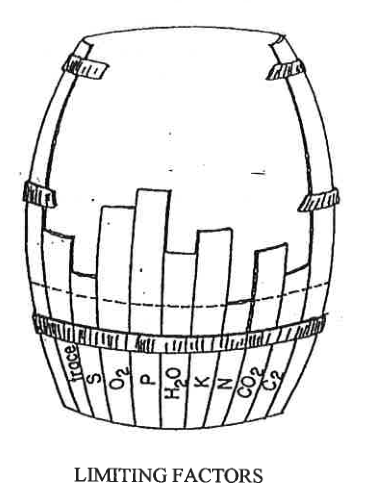
YIELD LIMITING VARIABLES WE CAN CONTROL
- Hybrid
- Population
- pH
- Weed Control
- Soil Tilth
- Drainage
- Tillage
- Fertility
- Planting Date
- Right Equipment – Adjusted Properly
- Pest Management
- Crop Rotation
- Harvest Date
- Planting Depth
- Fertilizer Placement and Timing
- Soil Life – Most Important
Howard
Sir Albert Howard commented that von Liebig’s views "remained those of a chemist who understood nothing about humus because he was enchanted with laboratory chemistry and dealing with only a fraction of all the facts."
Albrecht
William Albrecht commented "In our attempts to comprehend how the insoluble rock can make soil which, under proper moisture, will nourish plants, we have too long believed that the nutrient inorganic elements from the soil must be water soluble. Those elements need to be viewed in their compounds, in their larger molecules and as absorbed ions to give the lowest possible ionic activity when held by colloids requiring energies to exchange them and make them more ionic."
In short, he was saying that nature deals in insoluble nutrients and serves them up on signal through a complex biological system.
Von Helmont
Jon Baptista von Helmont, a 17th century Flemish physician started getting a handle on what happens when plants grow in the soil with his "tree experiment." He was trying to measure how soil matter was displaced when plants grow. To do this, he planted a willow tree in a large earthen tub. He planted a 5 pound sprig into 200 pounds of soil. The tub was then covered except for a small hole for the tree trunk and one for watering.
Five years later, the tree weighed 164 pounds. Von Helmont reasoned if the tree had picked up the difference between 5 pounds and 164 pounds, then the soil in the tub should weigh only 41 pounds. The results proved him wrong! After oven drying the soil, he found the 200 pounds of soil had lost 2 ounces.
2. Later observations of von Liebig
This is a translation of some later observations made in 1843 by Justis von Liebig, the father of NPK agriculture.
"I had sinned against the wisdom of our creator, and received just punishment for it. I wanted to improve his handiwork, and in my blindness, I believed that in this wonderful chain of laws, which ties life to the surface of the earth and always keeps it rejuvenated, there might be a link missing that had to be replaced by me - this weak powerless nothing."
The law, to which my research on the topsoil lead me, states, "on the outer crust of the earth, under the influence of the sun, organic life shall develop". And so, the great master and builder gave the fragments of the earth the ability to attract and hold all these elements necessary to feed plants and further serve animals, like a magnet attracts and holds iron particles, so as no piece be lost. Our master enclosed a second law unto this one, through which the plant bearing earth becomes an enormous cleansing apparatus for the water. Through this particular ability, the earth removes from the water all substances harmful to humans and animals - all products of decay and putrefaction, of perished plant and animal generations."
"What might justify my actions is the circumstance, that a man is the product of his time, and he is only able to escape the commonly accepted views if a violent pressure urges him to muster all of his strength to struggle free of these chains of error. The opinion, that plants draw their food from a solution that is formed in the soil through rainwater, was everyone’s belief. It was engraved into my mind. This opinion was wrong and the source of my foolish behavior."
"When a chemist makes mistakes in rating agricultural fertilizers, don’t be too critical of his errors, because he has had to base his conclusions upon facts which he can’t know from his own experience, but rather, has to take from agricultural texts as true and reliable. After I learned the reason why my fertilizers weren’t effective in the proper way, I was like a person that received a new life. For along with that, all processes of tillage were now explained as to their natural laws. Now that this principle is known and clear to all eyes, the only thing that remains is the astonishment of why it hadn’t been discovered a long time ago. The human spirit, however, is a strange thing; "Whatever doesn’t fit into the given circle of thinking, doesn’t exist"."
3. Vitality Theory of Soil Fertility
The vitality theory says that soil life is the basis for soil fertility. The greater the quantity and variety of life growing and feeding in and on soil, the better its fertility.
Siegfried Lubke’s definition of a fertile soil:
"A soil isn’t fertile because it contains large amounts of humus or minerals or nitrogen, but because of the continuous growth of numerous and varied microbes and soil life which break down and reconstruct nutrients from organic matter supplied by plants and animals into a plant available form. The populations of soil life benefit us by making minerals plant available, building humus, building slimes and the crumb structure of the soil. A soil teaming with varied forms of life is an excellent growth environment for plant roots."
4. The Composition of Soils
The more we learn about the complex plant/soil relationship, the more we realize how primitive our knowledge is. It is not clear today how many elements are essential or exactly how they interact with soil life to influence plant life. This is a list of the components thought to be contained in the top 6-2/3 inches of soil in three different soil types. (SEE FIGURE 1 AT END)
5. The Live Portion of the Soil
A closer examination shows the live portion to be extremely complex and varied. The following is one research team’s evaluation of that live portion.
Swipe the table to read all columns.
| Organism | number/acre | lbs./acre |
|---|---|---|
| bacteria | 800,000,000,000,000,000 | 2600 |
| actinomycetes | 20,000,000,000,000,000 | 1300 |
| fungi | 200,000,000,000,000 | 2600 |
| algae | 4,000,000,000 | 90 |
| protozoa | 2,000,000,000,000 | 90 |
| nematodes | 80,000,000 | 45 |
| earthworms | 40,000 | 445 |
| insects & other arthropods | 8,160,000 | 830 |
(M. Thompson & F. Troeh, Soils and Soil Fertility, 4th ed., 1978):
A. Aerobic - Anaerobic Soil Life
- Aerobic - Soil life that requires air. The most important group to agriculture.
- Facultative Anaerobic - Soil life that can live with or without air.
- Obligate Anaerobic - microbes which do not require air and are suppressed by it.
B. Soil Life Populations Can Be Increased
- They can be increased by changing system conditions that favor multiplication.
- Soils can be inoculated with new or additional populations.
C. System Conditions That Lead to Increased Numbers and Variety of Soil Life
- Soil Oxygen - Dissolved oxygen at 2+ ppm
- Soil pH - 6.0-8.0 Individual species favored by higher or lower pH’s
- Soil Temperature - Above 50°F - Ideal 70°-75°F
- Soil Moisture - 50-80% Field capacity
- Carbon - Crop residues and food sources must be in contact with soil. Soils with organic matter above 2% are desirable.
- Nitrogen
- Phosphorus, Calcium and Other Minerals - Certain heavy metals (i.e. chromium) are detrimental to microbe populations.
- Compost
D. Specific Populations of Soil Life have Different Functions
Each class is very specific in what it does. The bacteria, fungi and actinomycetes are rather immobile and do not move very far in the soil.
E. Relationships of Different Groups of Soil Organisms
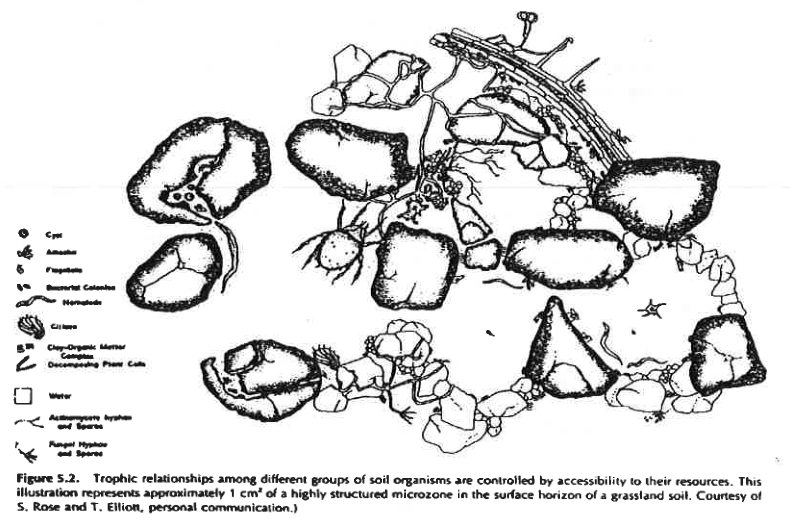
6. Humus
A. The Definition of Humus
There is no one good definition of humus. It has many facets – like a human being.
Some scientists have defined organic matter and humus as one in the same. This is not true!
Humus comes from organic matter as bread comes from wheat.
- Many things happen in the process.
- Many types of bread can be baked from the same wheat - many types of humus can be formed from the same corn stalk.
- Humus is produced by the impact of all soil life.
- Humus is built from a variety of ingredients. The better the quality and variety of organic matter, the better the humus.
There are different states of organic matter. It is not called humus while it is still being broken down.
B. The Influence of Humus on Soil Fertility
Because the humus fraction of the soil is so important and multifaceted, H.H. Koefp and others have described it as having two aspects. One aspect they call effective humus, the other they call stable humus. The influence of humus on soil fertility is summarized as follows:
Swipe the table to read all columns.
| Aspect | Effective humus | Stable humus |
|---|---|---|
| 1. Organic soil substances | Effective humus is decomposed and nourishes the microbic population of the soil. | Stable humus is permanent and combines with the soil minerals. |
| 2. Influence on nutrient supply | Microorganisms fix nitrogen out of the air; effective humus gives off nitrogen, phosphorus, sulfur, and other mineral substances during mineralization; effective humus mobilizes nutrients including trace elements from the soil minerals. | Stable humus contains supply of nutrients that are gradually released (old fertility). It stores available nutrients and prevents leaching. |
| 3. Soil structure | Microbial population of the soil helps to create and stabilize soil structure. | Stable humus makes light soils more plastic and increases their water-holding capacity; makes heavy soils more porous, improves aeration and their warming up; it forms the crumbly structure of the topsoil. |
| 4. Health and quality | Effective humus supplies plant hormones, antibiotics, and stimulates biological activity that inhibits the spread of pathogenic microorganisms. | Stable humus contains numerous active substances, stimulates biological activity; it includes a rich variety of microorganisms that inhibit the spread of pathogenic organisms. |
C. The Formation of Humus
Microbes take organic matter and convert it to longer and longer carbon chains. This is done only under ground by microbes that are very immobile. Microbes need carbon sources and nitrogen sources.
1. The Nitrogen Cycle
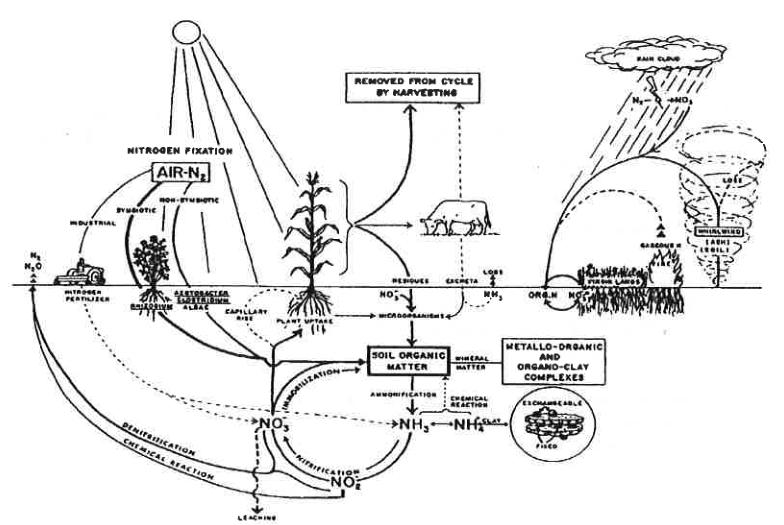
2. Phase I of Humus Formation
Numerous species of microorganisms break down protein from dead organic matter into peptones, amino acids, amines, ammonia, nitrite and nitrate.
Mineralization takes place so that from the original complex, nothing is left but the simplest compounds of the elements.
If the process went on indefinitely, only mineral matter plus CO₂, H₂O, N₂, NO₃, NH₃, SO₄ and O₂ would remain. However, it does not continue indefinitely.
3. Carbon Cycle
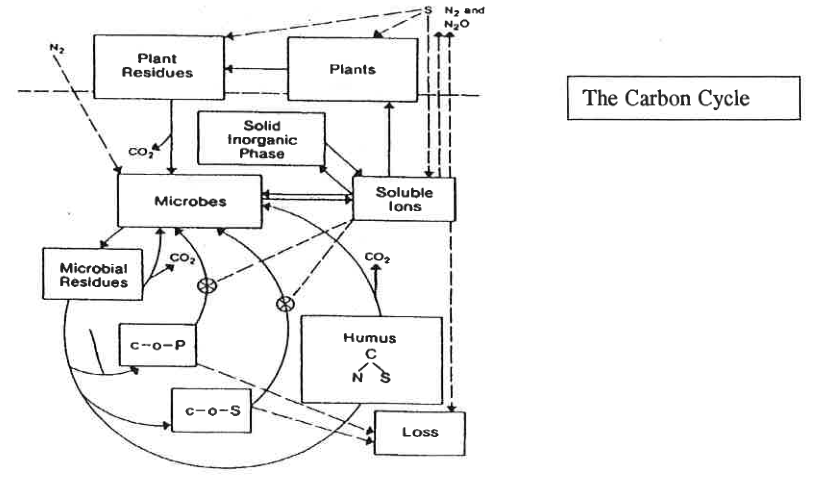
4. Phase II of Humus Formation
Other organisms take over as the second phase of humus formation. These stabilize the breakdown and build up again reversing the process
From simple chemical structures and pure elements, for instance carbon, oxygen and nitrogen, they produce sugars, carbohydrates, amino acids, and subsequently proteins and peptide chains.
7. Bits and Pieces in Conclusion
A.
The organic matter or crop residue can start out with a carbon nitrogen ratio of 100:1 or 25:1 and still end up as humus very near a C:N ratio of 12:1.
- As carbonaceous organic matter is consumed, microorganisms continue to grow by consuming their predecessors.
- Excess nitrogen applied to the soil will require the consumption of carbon or humus from the soil.
B.
Microbes eat first. It is important while planning cropping systems to remember that while microorganisms are taking nutrients they are denying them to the plants.
C.
Breakdown products from fresh manure may find their way back to plants, animals or man and cause toxic effects. For example, plants having absorbed scatols and indols cause increased gas formation during digestion. Cattle only bloat on pastures that have been over spread with mineral fertilizers or fresh manure.
D.
Plant roots excrete organic acids and enzymes, which in turn favor microorganisms, which in turn release more organic acids and enzymes. In a biologically active soil there is a continuous process of give and take, release and absorption, availability and taking into storage.
E.
The plant root rhizosphere is the site of the soil plant interaction. It contains many more microorganisms and more or less concentration of nutrient ions than the surrounding soil.
F.
All biochemical action is dependent on or related to the presence of enzymes. The variety of living organisms will determine the enzymes’ presence and the intensity of biological process. (See Figure 2 at end)
G.
Many aerobic microorganisms produce antibiotics that inhibit the spread of pathogens.
H.
The availability of phosphate to plant roots in a biologically balanced soil system is entirely different than chemical laboratory availability. Rock phosphates come available slowly, but steadily in an organic system. Most laboratory available phosphate can be fixed as inert iron or aluminum compounds at low pH and as inert calcium compounds at high pH.
I.
Water soluble potash in a soil goes easily where water moves - upward into the plant or downward away from it. Forage crops may absorb 5 to 6 times more potash than normal, being harmful to consuming livestock. Humus is the regulator to hold, to absorb, to avoid leaching or luxury consumption, yet hold the potash ready when the need arises.
J.
In stable humus we find practically no free ammonia, only a limited amount of nitrate, but a large amount of organic nitrogen. This organic nitrogen is contained in the proteins, amino acids, and other compounds of the life of microorganisms in soil or compost.
K.
Soil tests from two fields showed nearly identical chemical analysis. Yet one field produced maximum yields, the other average to medium yields. The difference between the two lay in the soil structure and the humus condition.
L.
Humus quality can be measured with chromatography.
Figures 1 & 2
Swipe the table to read all columns.
| Element | Sandy Loam lbs. per acre | Silt Loam lbs. per acre | Clay loam lbs. per acre |
|---|---|---|---|
| Organic Matter | 20,000 | 54,000 | 96,000 |
| Lbs. of Nitrogen | 1,340 | 3.618 | 6,342 |
| Live Portion (Earthworms, Bacteria) | |||
| Silicon Dioxide | 1,905,000 | 1,570,000 | 1,440,000 |
| Aluminum Oxide | 22,600 | 190,000 | 240,000 |
| Iron Oxide | 17,000 | 60,000 | 80,000 |
| Calcium Oxide | 5,400 | 6,800 | 26,000 |
| Magnesium Oxide | 4,000 | 10,400 | 17,000 |
| Potash | 2,600 | 35,000 | 40,000 |
| Phosphate | 400 | 5,200 | 10,000 |
| Sodium Oxide | 4,600 | 26,000 | 24,000 |
| Titanium Oxide | 13,600 | 18,000 | 14,400 |
| Sulfur Trioxide | 600 | 8,500 | 6,000 |
| Manganese | 2,500 | 2,000 | 2,000 |
| Zinc | 100 | 220 | 320 |
| Copper | 120 | 60 | 60 |
| Molybdenum | 40 | 40 | 40 |
| Boron | 90 | 130 | 130 |
| Cobalt | 50 | 50 | 50 |
| Clorine | 50 | 200 | 200 |
Approximately 2,000,000 lbs., or 1,000 tons. Compiled by J. L. Halbeisen and W. R. Franklin.
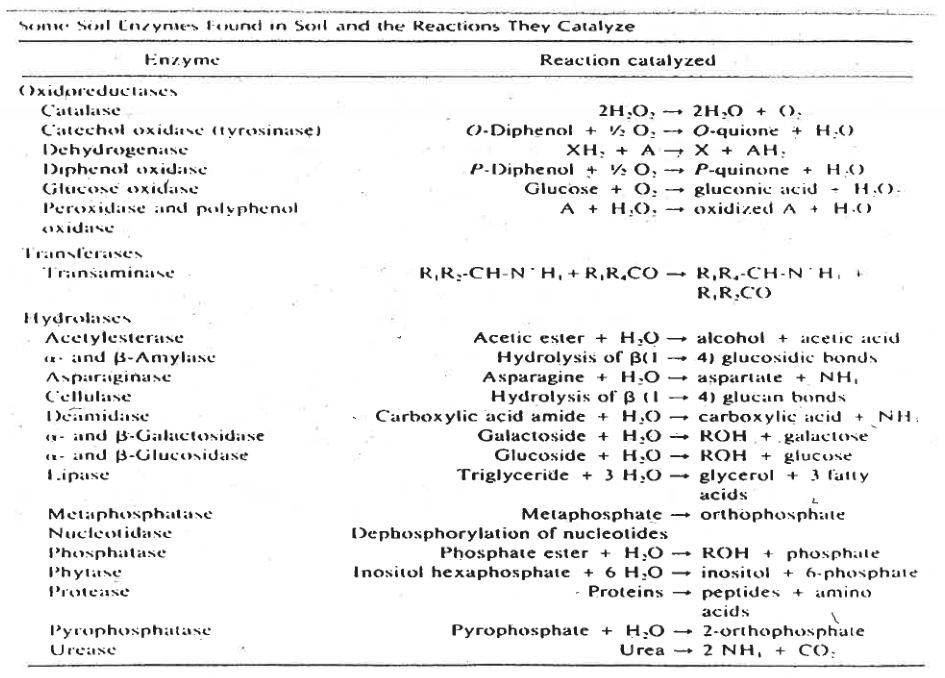
Swipe the table to read all columns.
| Enzyme | Reaction catalyzed |
|---|---|
| Oxidoreductases | |
| Catalase | 2H₂O₂ → 2H₂O + O₂ |
| Catechol oxidase (tyrosinase) | O-Diphenol + ½ O₂ → O-quinone + H₂O |
| Dehydrogenase | XH₂ + A → X + AH₂ |
| Diphenol oxidase | P-Diphenol + ½ O₂ → P-quinone + H₂O |
| Glucose oxidase | Glucose + O₂ → gluconic acid + H₂O₂ |
| Peroxidase and polyphenol oxidase | A + H₂O₂ → oxidized A + H₂O |
| Transferases | |
| Transaminase |  Enlarge original equation ↗ |
| Hydrolases | |
| Acetylesterase | Acetic ester + H₂O → alcohol + acetic acid |
| α- and β-Amylase | Hydrolysis of β(1 → 4) glucosidic bonds |
| Asparaginase | Asparagine + H₂O → aspartate + NH₃ |
| Cellulase | Hydrolysis of β (1 → 4) glucan bonds |
| Deamidase | Carboxylic acid amide + H₂O → carboxylic acid + NH₃ |
| α- and β-Galactosidase | Galactoside + H₂O → ROH + galactose |
| α- and β-Glucosidase | Glucoside + H₂O → ROH + glucose |
| Lipase | Triglyceride + 3 H₂O → glycerol + 3 fatty acids |
| Metaphosphatase | Metaphosphate → orthophosphate |
| Nucleotidase | Dephosphorylation of nucleotides |
| Phosphatase | Phosphate ester + H₂O → ROH + phosphate |
| Phytase | Inositol hexaphosphate + 6 H₂O → inositol + 6-phosphate |
| Protease | Proteins → peptides + amino acids |
| Pyrophosphatase | Pyrophosphate + H₂O → 2-orthophosphate |
| Urease | Urea → 2 NH₃ + CO₂ |